
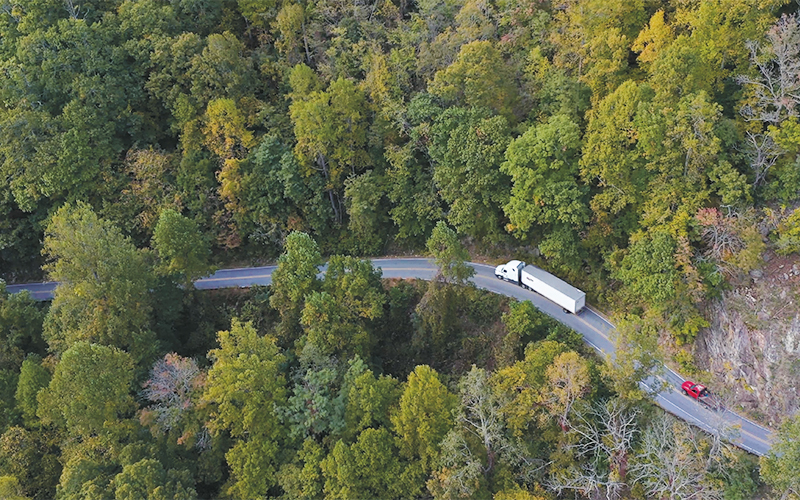
Starting in December, truckers will now have to worry about a fine that is several times the current one if they decide to take Highlands Road through the narrow Cullasaja Gorge.
This is the result of a state bill more than one year in the making that became law on July 8.
Starting Dec. 1, HB593 increases the penalty for trucks that drive U.S. 64/Highlands Road through the Cullasaja Gorge. The current maximum penalty is $200, but this new law will increase that to as low as $1,600 for an empty truck and up to $6,000 for a full truck.
The new fines go into effect for the 10.7-mile stretch from Walnut Creek Road (State Road 1533) to Dillard Road (N.C. 106) in Highlands. Signage at both intersections warns truckers of the road.
“The frequent incidents of large commercial trucks getting stuck on a segment of road in Macon County have created hazardous conditions for residents and first responders while diverting essential resources from the community,” stated Rep. Karl Gillespie (R-Macon). “HB593 aims to enhance road safety and ensure that our first responders can focus on serving and protecting our residents.”
The two-lane road narrows going through the Cullasaja Gorge and with the rock wall on the north side, blind curves, large drop-off into the gorge on the south side and no road shoulder, large commercial trucks can often take up both lanes and get stuck, causing backups both ways.
Gillespie previously said that the current $200 fine is not a deterrence for large commercial truckers, who otherwise would have to take Dillard Road.
The distance from the bypass exit to Highlands Road in Franklin to the Dillard Road intersection in Highlands is 16.7 miles. Going from the same two points but using Georgia Road and Dillard Road is about 29.5 miles.
HB593, originally entitled, “Restrict Truck Length Through Cullasaja Gorge,” passed the N.C. House in 2023. This year, the N.C. Senate took up the bill late in its short session.
Sen. Kevin Corbin (R-Macon) said the legal people in the General Assembly in Raleigh noted HB593 should be a public bill and not a local bill because it involves a U.S. highway that goes through multiple counties. While in a Senate committee, Corbin said four other senators had local situations they wanted to pass, so they got added as amendments to HB593.
“It was a little bit of a train with extra cars attached,” Corbin said of HB593.
The bill, now Various General Local Laws, passed the Senate 44-0 and re-passed the House 109-1 on June 25 and 27, respectively. Gov. Roy Cooper signed HB593 on July 8.
Other state business
The passage of the Cullasaja Gorge trucking bill was part of the North Carolina General Assembly’s “short session” from mid-May through the end of June. In the second year of the two-year biennium session, 2023-24, the legislature meets for a shorter period since most of the work was done the year before in the “long session,” including the two-year budget.
Gillespie said the short session was “particularly productive.” Corbin said it was a good short session even without the passage of a full budget bill.
Despite having a supermajority in both chambers, House Republican and Senate Republican leadership couldn’t agree on a full 2024 budget bill. Last year, negotiations on the two-year budget lasted several months.
Corbin said he pushed hard for $136 million in stopgap funding for childcare centers. The funding was approved through the end of 2024 as a means to cover a gap left by the June 2024 expiration of COVID funds.
Corbin said as chair of Appropriations on Health and Human Services, he asked for more funding to cover a longer period. Corbin said in 2025, if reelected, his No. 1 health care priority is getting more money for childcare.
“Usually, top priorities get funded,” Corbin said.
Two other Gillespie bills became law in 2024. HB911 removes a tract of land from the corporate limits of the Town of Andrews in Cherokee County, which the town requested.
The other was HB1074, the Constitutional Amendment/Citizens-Only Voting bill. The bill, which didn’t require the governor’s signature, puts a N.C. Constitution amendment change on the Nov. 5 election ballot that would revise the language regarding citizenship and eligibility to vote.
The amendment asks voters to change the entitlement to vote from “Every person born in the United States and every person who has been naturalized, 18 years of age” to “Only a citizen of the United States who is 18 years of age.”
“Polling shows North Carolinians overwhelmingly support a citizens-only voting amendment to our state’s constitution,” Gillespie said. “It is a commonsense measure to further safeguard and uphold the integrity of our elections.”
Corbin got one of his bills to become law in 2024. SB776 re-arranges some staggered terms of local community college boards of trustees, including Southwestern Community College. Corbin said the bill ensures fair representation for each county on those boards of trustees.
Corbin lauded the passage of HB237, the short session’s most controversial and talked-about bill, which, among other election law changes, criminalizes mask-wearing as part of protests and increased penalties for those wearing masks as part of committing a crime. Corbin said the law takes the mask laws to what they were pre-COVID.
Gillespie noted the N.C. House passed two bills he primarily sponsored: HB984, Removal of Squatters from Private Property, and HB1042, Vet Care for Retired Law Enforcement Dogs. The Senate has not considered either bill.
Corbin also praised the General Assembly passing this year’s teacher raises, which over the last two years have been 7%. Another mini-budget bill increases supplements for rural teachers, covering the seven westernmost counties of North Carolina. The supplement varies by county depending on population, tax value, tax rate and poverty level.
Corbin also lauded the extension of the isolated schools supplemental funding, which gives Macon County Schools $1.5 million each year for having two K-12 schools. Corbin noted he first got the supplement in 2017, his first year in the N.C. General Assembly.
The General Assembly passed an adjournment resolution on June 28. It includes return dates of July 10, 29, Aug. 1, Sept. 9-11, Oct. 9, Nov. 19-22 and Dec. 11-13 if needed. However, Corbin said there are no plans to use any of those dates and said state business is “pretty much done” in 2024.