
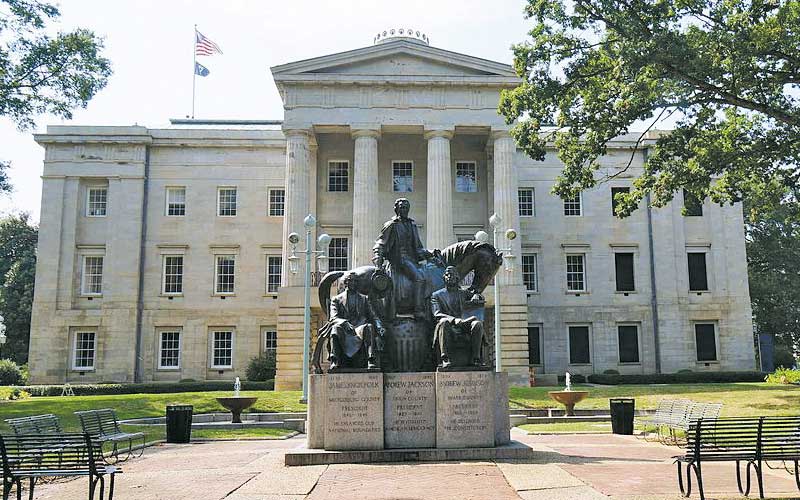
More Helene relief funding, local needs and other hot-button issues such as the DUI threshold and medical marijuana will be major points in the North Carolina General Assembly 2025 long session, which begins today (Jan. 29).
Sen. Kevin Corbin finds himself chairing two powerful senate committees this biennium: Appropriations of Education/Higher Education and Education/Higher Education. Corbin represents Senate District 40 including Macon, Cherokee, Clay, Graham, Jackson, Swain, Transylvania and part of Haywood County.
Corbin said when joining the Senate several years ago, he wanted to be the chair of the Senate’s education committees given his school board experience but got health instead.
With Medicaid Expansion passed and 600,000 people signed up, Corbin got a new challenge for 2025-26.
“Sen. Berger called me several weeks ago and said, ‘How would you like to have education?’ So I feel like I did my job and helped, and he’s asking me to move over,” Corbin said. “So, I’m very honored to be asked to take that. I’m happy to do it. It is something I’m very comfortable with and very familiar with.”
Corbin said his two chairman positions account for all the education spending in North Carolina, from Pre-K through public schools, the North Carolina Community Colleges System and the University of North Carolina System, altogether making up roughly 52% to 53% of the state budget.
For Rep. Karl Gillespie, the House Majority Whip, he has a new House Speaker in Rep. Destin Hall, a Lenoir Republican, which he called “extremely positive.” Gillespie represents House District 120 of Macon, Clay, Cherokee and Graham counties.
“Representative Hall and I came into the legislature together back in 2016, so we’ve been friends for eight years,” Corbin said. “We know each other very well, been out to a lot of meals together, shared a lot of conversations when we were both brand new and freshmen.”
Members of the state legislature converge on Raleigh today (Jan. 29) to start the long session. The long session is where the bulk of the two years of work will be done, including the biennium budget. The budget is due by July 1, the start of the new fiscal year, but recent long sessions have extended well past July 1 as negotiations between the House and Senate dragged into the fall. The 2023-24 budget passed into law on Oct. 3, 2023, after the legislature took votes in late September.
While the budget is a top priority over these next several months, there will be hundreds of bills filed by the 170 legislators. Sitting in key positions, Gillespie and Corbin aim to make their mark in 2025.
Helene recovery
In late 2024, the N.C. General Assembly passed three bills that included Helene-related spending. As the vice chair of the House Select Committee on Helene Recovery, Gillespie said there will be another Helene bill.
“That’s going to be a number one priority for the legislature,” Gillespie said about a new Helene spending bill. “I believe that Speaker Hall has made comments to that effect in his acceptance speech that Western North Carolina was a priority. The governor has made several comments about being a priority, so I hope that we will be able to work with those affected parties and I believe we will be able to come up with a spending bill.”
While Gillespie noted House District 120 wasn’t impacted as much by Helene, Corbin’s senate district has more Helene-affected areas and will have more to ask.
“The largest storm relief package that has been done in history [of the state] has been about $500 million…and that was I believe for Florence in 2018,” Corbin said. “And so we’ve doubled that already, and we’re not done.”
Corbin said the Helene damages are estimated at $60 billion, which is too much for the state’s $5 billion Rainy Day Fund.
“Prior to this happening, we had people telling us that that was unneeded excess money, that that was in excess, it was over the top, we didn’t need $5 billion in the bank,” Corbin said. “Well, guess what? Now it doesn’t look too bad, except we don’t have enough.”
Corbin feels after talking with other WNC legislators that the fourth Helene spending bill from the state will come in February.
“We’ll pass the main budget to be effective July 1, but we don’t want to wait that long for more storm relief,” Corbin said. “We want to get as much money as we can headed toward that.”
The state has allocated $1.1 billion from the Rainy Day Fund so far, so replenishing those funds is a priority this year, both Corbin and Gillespie confirmed.
With the State House one seat short of a Republican Supermajority (which can override a governor’s veto), Gillespie believes this is an excellent opportunity to work across the aisle to craft a biennium budget.
“I’m confident that we will be able to come to terms on a budget that we all might not be happy with, but we’ll be satisfied with, and we’ll be able to support it together,” Gillespie said of the budget.
Medical marijuana
Currently illegal in North Carolina, the state Senate passed a medical marijuana bill in 2023-24, but it didn’t go to a full vote in the state House.
Gillespie said he didn’t know if it would come up this year, saying, “Anything is fair game in Raleigh to be brought forth.” Gillespie feels the right medical marijuana bill could benefit a segment of the population, but it needs to be crafted correctly with checks and balances.
“If the federal government would move on [medical marijuana] to provide us some guidelines, it would be much easier, but I don’t know if that is going to happen,” Gillespie said. “I think at this point it appears it’s going to be up to the states to decide how to handle that.”
Corbin explained that Sen. Bill Rabon, a Southport Republican, is a steadfast supporter of medical marijuana after it helped him during cancer treatments.
“Will it come up? 100% chance. I voted for it last time, and I will again,” Corbin said of medical marijuana. “I was really on the fence about it, but in the end, I was convinced by medical folks, especially the ones that talked about how what we’ve used for the last couple decades is opioids, and you see how that turned out…and it’s been proven that marijuana doesn’t do that.”
Corbin said while the Eastern Band of the Cherokee Indians in Cherokee fully legalized marijuana in the Qualla Boundary, recreational marijuana “would not have the votes” in the state Senate this year.
Part of the 2023 state budget negotiations was adding casinos to non-native lands in central and eastern North Carolina. Corbin, whose district includes the entire Qualla Boundary, said his vote depends on how the tribe feels about non-native casinos as it could affect the two EBCI casinos (one in the Town of Cherokee and one in Cherokee County).
DUI bill
A bill Gillespie feels will move forward this year is lowering the DUI blood-alcohol limit from 0.08 to 0.05. He said the WNC Task Force supports the bill.
Both Gillespie and Corbin noted the differing opinions across law enforcement on lowering the DUI limit.
“I would lean heavily on their opinions to make sure that is sensible legislation,” Gillespie said of the DUI legislation.
“I’ve had some say that the 0.08 is sufficient. I’ve had some say that if you put it to 0.05 for some people, that might be half a glass of wine,” Corbin said.
Rep. Mike Clampitt, a Bryson City Republican, has been taking the lead on introducing the 0.05 DUI limit legislation later this session.
Commissioners’ redistricting bill
Last year, both Corbin and Gillespie introduced local bills that would change elections for the Macon County Board of Commissioners. Currently, one commissioner is elected from District 1 (Highlands, Sugarfork, Flats and Elijay), three from District 2 (Iotla, Millshoal, North Franklin, East Franklin, South Franklin, Union and Smithbridge) and one from District 3 (Burningtown, Cartoogechaye, Cowee and Nantahala).
In December 2023 the commissioners passed a resolution asking the state to change two of the District 2 seats into at-large seats, meaning anyone in the county could run for them. The purpose would be to allow anyone in the county the opportunity to run every two years. Currently, District 1 and 3 residents can only run for a commissioner’s seat every four years, and District 2 seats are staggered so at least one is open every two years.
Gillespie noted the change to the Macon County Board of Commissioners with Barry Breeden joining the board after the November election, so he would like that to be supported by the current board before he introduces a new bill.
“If that’s something that the Macon commissioners would like done, they’d pass a resolution in support of it and then we would just run it as a local bill,” Gillespie said.
Corbin said Gillespie and he must agree on something before introducing the local bill, so it won’t just pass one house and then die in the other.
“If he wants to do it, I won’t oppose it,” Corbin said of the Macon County Commissioners redistricting bill.
Local requests impacted?
The ripple effects of more Helene recovery funding and replenishing the Rainy Day Fund might mean less money for other needs in this year’s budget.
“I have no expectation that we’ll cut any part of the budget,” Corbin said. “I think what you’ll see is maybe a reduction in special projects, capital spending, which we’ve been pretty free with that money in the past as far as helping with capital projects…So will we cut back on some of those funds? The answer is probably yes.”
However, Gillespie feels municipal leaders understand the situation.
“It’s been very refreshing to me as in the conversations that I’ve had in my district about funding, all my accounting town folks I’ve talked to have said, ‘You know we’re going to send you our funding requests but we fully understand the needs of east of here, and while we need these funds, if we don’t get all of it because part of it needs to go to our friends to the east of us, we want that to happen,’” Gillespie said.
One of the first tasks for representatives is collecting requests from municipal governments. Gillespie said they’ll have their local requests by Feb. 1, to turn it around quickly, especially local bills, due to be filed by Feb. 15.
“Senator Corbin and I, I think do a great job working together when we reach out to our local governments – cities, towns, counties, nonprofits,” Gillespie said. “We depend on them to come up with those lists of needs for the budget.”
Corbin said he’s allowed one placeholder local bill, which is essentially a blank bill that can be filed before that Feb. 15 deadline and then filled in later.
“Our goal is to have a budget by July 1, so between now and then, there’s gonna be a lot of bills moving, a lot of budget items moving, it’s almost the first of February now so we’re now working on things now that’ll make it by the first of July,” Gillespie said.
Other legislation Gillespie plans on bringing up again in 2025 is allowing the use of tribal ID to purchase alcohol and tobacco. Another is known as the Sawmill Bill, which would allow people to sell timber off their land to be used in residential building structures. Gillespie said the Sawmill Bill got wide support in 2024 and he hopes to get it passed in 2025. Gillespie also supports a retired K9 medical funding bill, which he said has received no opposition. Another request is a Squatters Bill that Gillespie said would protect people’s vacation homes.