
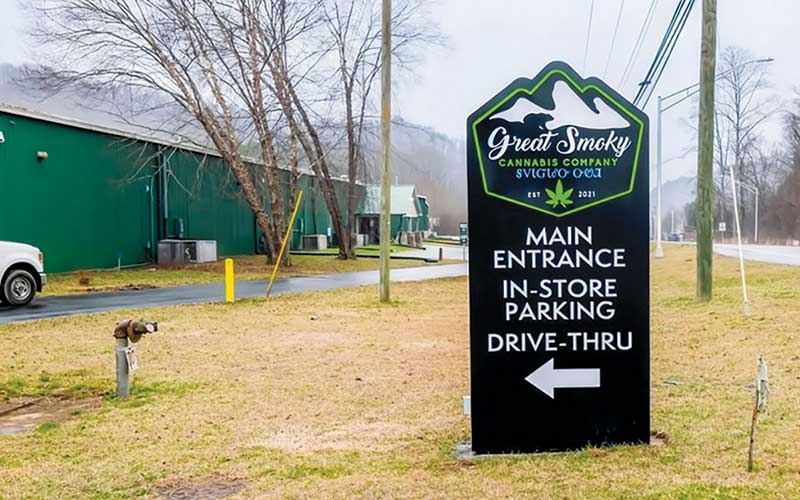
As the Eastern Band of the Cherokee Indians plan to begin medical marijuana sales on April 20, eyes turn to the areas surrounding the Qualla Boundary, where it is still illegal.
“Our world-class dispensary is a seed-to-sale operation. Upon opening, this facility promises to revolutionize the landscape of medical cannabis on the Qualla Boundary. With a commitment to quality, compassion, and education, Great Smoky Mountain Cannabis Co. aims to provide patients with safe and regulated access to medicinal cannabis products,” stated Qualla Enterprises LLC, the EBCI-owned tribal entity that runs the Great Smoky Cannabis Company. “The new dispensary will open with high-quality tested products – including flower, vape products, edibles, topicals, and more – carefully curated to meet the diverse needs of patients. Product selection will continue to grow and evolve each month.”
Medical marijuana sales will start nearly three years after EBCI voters approved the measure in May 2021. Medicinal sales will start with patients issued a medical card by the EBCI Cannabis Control Board and to individuals with out-of-state medical cards or other tribal medical cannabis cards.
On Sept. 7, 2023, tribal members voted 70% in favor of a referendum legalizing the possession and use of cannabis for individuals aged 21 and older and requiring the EBCI Tribal Council to pass legislation to regulate the marijuana market.
However, according to a March 28 joint statement from the EBCI Tribal Council, as first reported by the Cherokee One Feather (a newspaper owned and operated by the EBCI), recreational sales won’t happen yet.
“We have approached this responsibility seriously so that any legislation concerning cannabis is practical and thoughtful. This is a process that cannot be rushed; there are numerous factors to consider so that we are able to make the best decisions as these are decisions that can have significant long-term impacts on our tribe,” the tribal leaders’ statement reads.
“Work is continuing to progress with the executive and legislative branches, and we are committed to make sure that any administrative efforts and legislation concerning recreational cannabis use is implemented responsibly,” the tribal leadership’s statement concludes. “We will continue to provide updates as we move forward.”
Despite nearly half the states legalizing recreational and medicinal marijuana, the drug remains illegal in North Carolina, Tennessee, Georgia and South Carolina.
The EBCI has a 22.5-acre cannabis farm with a 47,404-square-foot dispensary. The tribe anticipates medical-only sales will bring in $208 million in sales.
North Carolina has partially decriminalized marijuana possession of half an ounce or less. The state-mandated punishment is a Class 3 misdemeanor, but any sentence must be suspended, and the maximum fine is $200. There are no decriminalization laws for marijuana in Tennessee, Georgia or South Carolina.
Cannabis is different than cannabinoid, or CBD, that’s been legal in North Carolina since 2015. Cannabinoids sold in North Carolina have a THC concentration (the medical compound that creates the psychoactive effects of marijuana) of less than 0.3%. Both cannabis and cannabinoids come from the hemp plant. Tennessee and Georgia also allow CBD sales, but it’s still illegal in South Carolina.
The region is becoming more of an outlier in marijuana legalization. Currently, 24 states have fully legalized marijuana. Less than 10 states criminalize all forms of marijuana possession.
North Carolina’s State Senate passed medical marijuana last year, but the State House did not take it up and likely won’t in 2024.
According to Meredith College, which regularly polls North Carolinians on political hot-button issues, as of January, 78% of people support the passage of a medical marijuana bill, while 18% are opposed. These numbers are up 5% from last year’s 73%. And a majority of every demographic group in the state supported the legislation.
As the April 20 Cherokee medical marijuana sale date approached, local law enforcement affirmed their commitment to enforcing the state’s laws.
District Attorney Ashley Hornsby Welch of the 43rd Prosecutorial District (the seven westernmost North Carolina counties Macon, Cherokee, Clay, Graham, Swain, Jackson and Haywood), said on April 3 they will enforce the state’s medical marijuana ban.
“The mission, duty and privilege of the 43rd Prosecutorial District is to enforce state laws,” Welch stated. “We do not pick certain laws to enforce and ignore others.”
“Tribes have inherent authority as sovereign nations, subject only to federal, not state, law. We respect tribal sovereignty, and we respect the Eastern Band of Cherokee Indians’ right to enact tribal laws,” Welch continued. “In North Carolina, the cultivation, distribution and possession of marijuana remains illegal, and we will continue to enforce state law off Qualla Boundary.”
Captain Jonathan Phillips with the Macon County Sheriff’s Office said while there have been discussions among the WNC sheriffs about Cherokee’s medical marijuana sales, MCSO “doesn’t foresee it affecting daily operations.”
None of the Qualla Boundary is on Macon County property. Most of it is in Swain County, with parts in Jackson County and isolated sections in Graham and Cherokee counties, stirring questions about Great Smoky Mountain Cannabis Company transporting cannabis across state roads.
“I have met with the tribal attorney general and EBCI police attorney and they have assured me that this will not be transported on any state land and only enrolled members will be driving the trucks,” Swain County Sheriff Curtis Cochran said. “Myself, along with [District Attorney] Ashley Welch have told them that we will enforce and prosecute any drugs that are on state properties.”
Clay County Sheriff Mark Buchanan said there might be a little increase in possession charges but noted there’s no Qualla Boundary lands in Clay County.
North Carolina’s U.S. Senators, Thom Tillis and Ted Budd, sent a letter to various federal, state and tribal officials saying this will make it difficult for state and federal officials to uphold anti-marijuana laws outside of the boundary.
According to media reports, tribal spokesperson Sheyahshe Littledave called the senators’ letter “replete with misinformation and inflammatory language that promote fear and misunderstanding.”
U.S. Rep. Chuck Edwards, who represents WNC, introduced a Congressional bill that would defund all federally subsidized areas that allow marijuana sales and wrote a letter against recreational marijuana before the Cherokee vote. That bill, H.R. 5323, has not moved since it was introduced and sent to the U.S. House Committee on Transportation and Infrastructure.