
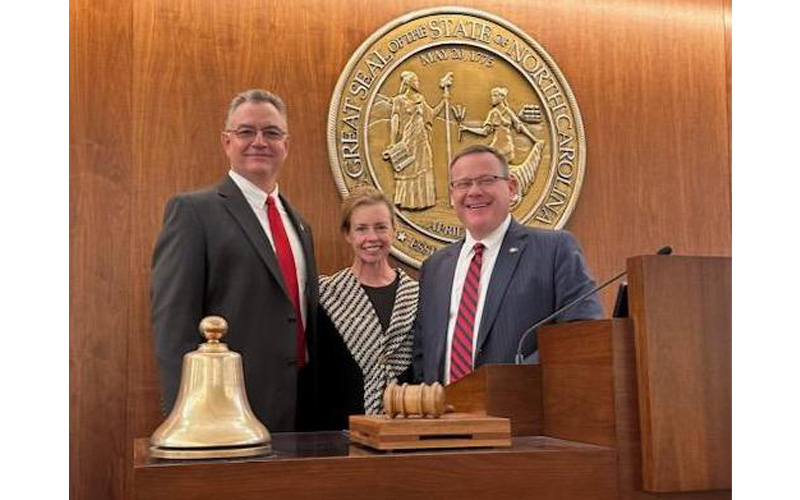
Starting this month, state Rep. Karl Gillespie and Sen. Kevin Corbin, both Franklin Republicans, will be making the roughly 600-mile round-trip journey to Raleigh each week for the North Carolina General Assembly’s biennium long session.
“I gotta be honest with you, I enjoy being in the General Assembly, I love representing Western North Carolina, it’s a great position to have…but I can’t emphasize this enough, I hate the drive, and I do it every week,” Corbin said during a recent interview, adding that he’s only stayed one weekend in Raleigh in his six years as a legislator. “I do it every Monday morning and drive back every Thursday night…I tell people the first 200 times I did it, it was kind of fun, still new, but the drive is old now.”
During the last long session in 2021-22, both Corbin and Gillespie logged countless thousands of miles driving back and forth to Raleigh for the 199 legislative days over the course of 14 months, the longest legislative session in state history. Along with Bryson City Republican Mike Clampitt, WNC legislators have the longest commute of the entire 170-member NCGA.
“It certainly didn’t get any shorter, the longer the session went, I can tell you that,” said Gillespie, who was a freshman representative in 2021-22. “I knew how far it was to Raleigh when I ran. It is a drive…we want to make every trip count.”
One thing both Franklin representatives agreed on is that despite the drive, the voices of Western North Carolina will be heard in the NCGA’s meeting and legislative chambers over the next several months.
The NCGA in 2023
The 50-member N.C. Senate and 120-member N.C. House convened Jan. 11 for the swearing in of all 170 members, who are all elected to two-year terms. On Jan. 25, the biennium’s long session is gaveled in for both chambers.
“I am very excited to get started on my second term in the North Carolina House of Representatives,” Gillespie stated after the swearing in ceremony. “I will continue to advocate and work tirelessly for the mountain values of Western North Carolina while in Raleigh.”
The long session is the term used for the first of the two regular sessions in the two-year period, taking place in an odd-numbered year. The overarching purpose of the long session is to cultivate and pass into law a biennium state budget by June 30, the end of the fiscal year.
The 2022 elections gave Republicans a narrow supermajority in the N.C. Senate with 30 of the 50 seats (up from 28) while falling one seat short of a supermajority in the N.C. House with 71 of the 120 seats (up from 69). A supermajority in both chambers would negate the need for Democratic Gov. Roy Cooper’s signature on a passed bill, as a 60% vote on a vetoed bill can override the governor.
On Jan. 10, N.C. Senate President Phil Berger announced intended committee appointments for the next two years. Corbin was named a chair for Senate committees on health care, and appropriations on health and human services. Corbin is also a member of four other committees: commerce and insurance, education/higher education, pensions and retirement and aging, plus state and local government.
State House intended committee assignments were not announced by press time.
Funding priorities
With two years of experience behind him, Gillespie thinks there might be some budget challenges due to the economy and inflation.
“I’m anxious to see what our projected numbers will look like and how that’ll impact our budget, particularly how it’ll impact some of the projects that our commissioners and town board members bring forward that’s a priority for our communities and how we’ll be able to get those funded,” Gillespie said. “We don’t know how severe the impact will be.”
Gillespie said one of his goals for the budget is to lower taxes for citizens to create more spendable income, and he feels confident that will be done.
When asked about priorities for the 2023 long session, Gillespie said he’s waiting to get priority lists back from county and municipal officials in his district which includes Macon, Graham, Clay and Cherokee counties.
“The things I work toward in the N.C. House are things I don’t come up with, those are things and priorities brought to me by groups of citizens, by our county commissioners, by our town board members, just like our projects that we work to get funded,” Gillespie said.
Corbin said he hopes the bipartisan work in 2022 will continue.
“As long as that’s the attitude, we’ll be able to pass a budget that everyone agrees on, that the governor agrees on,” Corbin said. “Ideally we’ll conclude the session by July 4. If everything works well the way it should, we should finish around that time period.”
Some of Corbin’s wants are additional money for schools, both K-12 and post-secondary, including continuing to earmark $1 million in additional funding for the Nantahala and Highlands K-12 schools. Corbin also noted several residence hall and capital outlay projects for Western Carolina University and Southwestern Community College.
“I’m pro-education,” Corbin said. “Since I have been down there, I’ve had the reputation of pushing for funds for our public schools.”
Corbin said that in the last full budget, there was more than $200 million earmarked for special projects in Western North Carolina.
Corbin added that he’s also got to get priority lists from all eight of his counties – Macon, Jackson, Swain, Graham, Cherokee, Clay, parts of Haywood and for the first time this term, Transylvania. Additionally, he said talking with his regional House colleagues, Gillespie, Clampitt and Canton Republican Mark Pless, did a lot of good.
“We found a lot of success in working together by doing that,” Corbin said. “We were extremely successful in getting money to our district.”
Both men said talking about WNC’s needs to representatives from across the state has been fruitful.
“They might not be from the mountains or never been to the mountains, but they understand that we have some different things to deal with up here and are willing to work with us,” Gillespie said of his eastern colleagues. “That has been one of my most pleasant surprises when I talked to my colleagues from urban areas about certain pieces of legislation that may be passing through the N.C. House.”
Corbin said fellow rural legislators have partnered together.
“We don’t begrudge our larger metropolitan areas…but we have specific needs in rural North Carolina,” Corbin said. “I found out the legislators from central and eastern North Carolina who represent rural counties like I do, we all have the same kind of needs. Whether you’re in the mountains, piedmont or the sandhills, a rural county is a rural county.
“We do have the same kind of issues, we have low population, some of the rural counties have higher-than-average poverty rates, we have school systems. I found that rural counties are very similar….in larger part, they help me to get funding for our end of the state, and I’ve helped them.”
Medicaid
One of the big stories coming out of the NCGA in 2022 was the state Senate passing Medicaid expansion, but the state House not holding a vote on the bill. Now with the long session, Corbin feels this is now the time.
“It’s no secret, I kind of led the charge for that in the Senate,” Corbin said. “We basically were able to take the Senate from overwhelmingly opposed to Medicaid expansion to finally getting it to a vote on the floor and having only two ‘no’ votes.”
Corbin said his first goal is to work with his House counterparts on a Medicaid expansion plan.
“It’s a complicated issue, which always makes it difficult, but I think it’s doable,” Corbin said, adding that 600,000 state residents currently are uninsured due to being in the gap between Affordable Care Act coverage and current Medicaid requirements. “It’s just the right thing to do, it’s the moral thing to do, and so that’s a huge priority for me to work to get that done.”
Gillespie said in the last biennium, 2021-22, there was a study group to look at Medicaid, but said they were cut short by the end of the session.
“I think we were going down the road to come up with a plan that was best for all North Carolinians,” Gillespie said. “We’ve had numerous conversations with constituents both for and against Medicaid expansion, so it’s been a topic of discussion and will continue to be as we move forward.”