
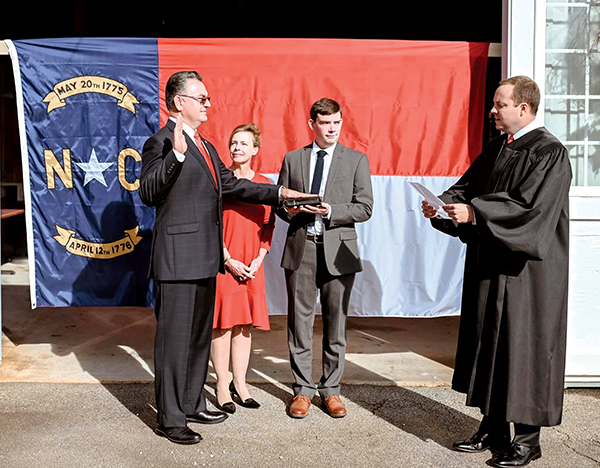
Kevin Corbin and Karl Gillespie are ready to hit the road to Raleigh to represent Western North Carolina in a General Assembly that will look mostly unchanged in the new year.
In November’s elections, Democratic Gov. Roy Cooper held on to his job while Republicans maintained their advantages in both houses of the General Assembly. Republicans did not gain enough ground in the legislature to establish a veto-proof supermajority, meaning they will still need to reach across party lines and work with the governor to turn bills into laws.
However, Corbin, who is making the switch from the House to the Senate, said he expects that this won’t be an issue. He said that when the pandemic began earlier this year, leaders of both parties didn’t have much trouble setting their differences aside to do what was best for citizens, and he expects the same approach in 2021.
“I got a nice letter from the governor committing to work together for the good of NC, and he has my promise of the same,” Corbin said. “You know the two political parties do have some differences, and some things we will just simply not be able to agree on. However, most people would be surprised to learn that 85-90 percent of legislation is passed on a bipartisan basis.”
As for what form that legislation takes in the new session, Corbin will have some new help in Raleigh. He won the senate seat previously held by Macon County’s own Jim Davis by a large margin in the election, and his own seat in the House will be filled by Gillespie, an outgoing Republican Macon County commissioner.
Gillespie said he and Corbin both place a lot of value on issues that affect rural communities like Franklin, and the two have spoken about policy priorities to push with their colleagues.
“We will work to provide additional funding for broadband expansion, look at how we can increase funding for education and how the current funding model impacts school systems in rural counties, expand funding for small agriculture projects, expand funding for the preservation and use of natural resources and continue to work to find solutions that would provide affordable healthcare for those in rural counties,” Gillespie said. “I am sure we will be working closely on a multitude of issues that will benefit the citizens of Western North Carolina.”
Developing specific bills around these ideas will take time, but Corbin expects that teamwork will be the deciding factor in whatever Macon County’s delegation pursues. As COVID-19 continues to play a major role in shaping state policy, he expects that legislators from rural regions will need to band together more than ever to take care of their districts.
“More than once, I have teamed with rural legislators from the east to fight for rural funding and for formulas for funding that benefit rural counties,” Corbin said. “One small example was that I fought hard to make the CARES ACT money to counties have a base amount before doing the per capita funding. … That meant almost nothing to Mecklenburg or Wake, but was a big deal here.”
Whatever plans arise in their discussions with their new colleagues, Gillespie and Corbin agree that the issues affecting Western North Carolina residents will be first and foremost in their minds.
“The citizens of North Carolina made their choices,” Gillespie said. “I will do my best to work with all my fellow legislators and other elected officials to benefit the citizens of the 120th house district.”
The 2021 legislative session will begin on Wednesday, Jan. 13.