
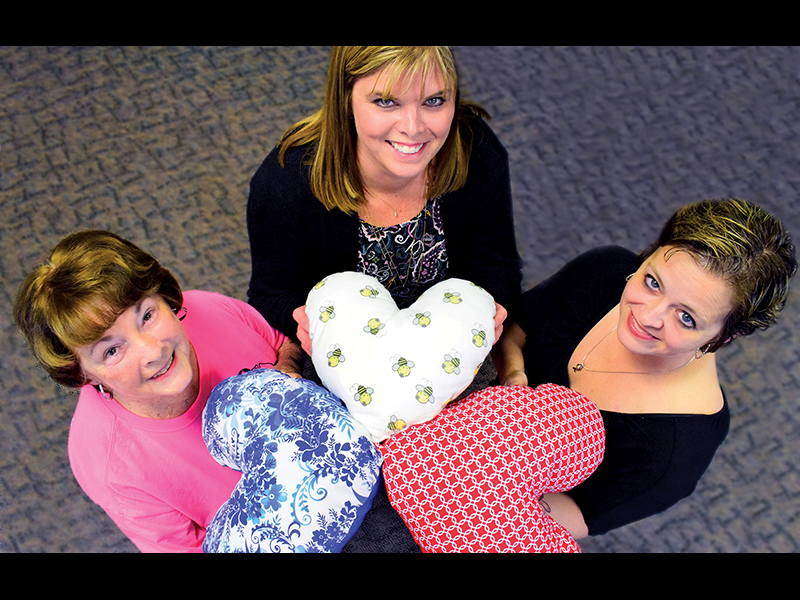
One in every eight American women will be diagnosed with breast cancer at some point in their lives. Many of those women live in Macon County, of different ages and diverse backgrounds.
There’s one thing that they all seem to be in agreement about, however, and that’s the importance of early detection through regular mammograms.
Lori Smith went into Angel Medical Center for a mammogram in January, not expecting to find anything. It turned out that she had caught breast cancer in the early stages, a discovery that motivated her to spread the word. She told a friend of hers about the experience, and the friend felt compelled to get a mammogram of her own. The result was a second diagnosis. At the time, Smith was 47 and her friend was 40.
“Even if you don’t feel something in your chest, get checked,” Smith said. “If you do feel something in your chest, get checked. If you’re a man and you feel something in your chest, you get checked too.”
About one in six breast cancer cases affect women in their 40s, but that’s far from all cases. Rita McElroy was 75 years old when she was diagnosed, and she was motivated to move quickly – she had already lost two brothers to complications from chemotherapy. She had no history of breast cancer in her family, however, so the diagnosis came as a surprise to her.
“I didn’t have any family history,” McElroy said. “I had no reason to expect it at all.”
Surprises are a common problem with diagnosing cancer. In the spring of 2018, Gwen Bradley-Stanfield noticed what she thought was a lump in her right breast. She consulted her doctor about it for a clinical exam, and while he didn’t find anything, he suggested that she follow up with a mammogram. The results came as a shock to Bradley-Stanfield, who thought she might have a tumor on the right side but actually had one she didn’t even notice on the left.
Early detection was a critical step in Bradley-Stanfield’s journey to becoming cancer-free, but it was still a long and difficult fight. Over the course of the next year, she underwent eight different surgeries, including a full hysterectomy and mastectomy. Some people have told her that having an excuse to get some work done is a silver lining to the experience; she assures them that that isn’t the case.
“It’s not a boob job,” Bradley-Stanfield says. “You’re left looking like Frankenstein and there’s not much that they can do about it. The body image issues are horrible afterwards.”
Heart-shaped pillows
These three survivors and several others are trying to alleviate some of the pain for the next ones in line. They get together to sew special heart-shaped pillows that are given to breast cancer patients for their recovery from surgery. The heart communicates the love among survivors, but it also has a more practical purpose – dealing with a drainage tube under the arm is one of the most uncomfortable parts of getting a mastectomy because of the way the tube is squeezed between the arm and the torso, so a heart-shaped pillow slots perfectly under the arm to relieve the pressure.
Angel Medical Center public relations manager Nancy Lindell said that every woman should get an annual mammogram starting when she turns 40. The goal is making sure that nobody of any age or gender falls behind in their fight because they didn’t know to check.
“Our job is to provide everyone with the understanding of how important mammograms are,” Lindell said. “This makes for a great tool, and more people should take advantage of it.”
October is Breast Cancer Awareness Month.