
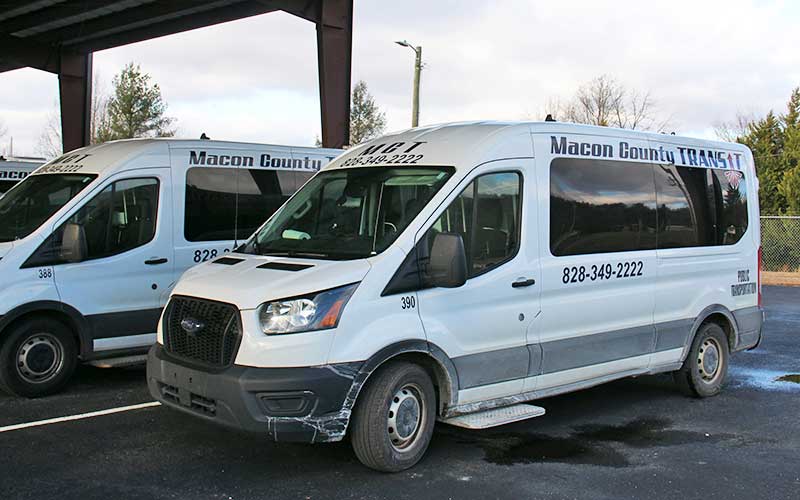
Macon County Transit is still rolling out services for residents, and the director sees change on the horizon.
MCT was founded in 1999 as the Departments of Social Services and Senior Services realized their buses were going to the same places at the same time. Since then, the department has grown to 16 vehicles running routes within and outside the county to Sylva, Asheville, Waynesville, Clyde, Cashiers, Bryson City, Dillard and Clayton. The Mountain Gem Route runs Monday-Friday with two busses circling Franklin and connecting the library, downtown square, Walmart, Westgate Plaza and the Ingles grocery stores on Georgia Road and Holly Springs Shopping Center.
The “WNC Express” takes residents from Franklin to Asheville from 8 a.m. to 5 p.m. Monday-Friday. Local fares for the Mountain Gem route are $1 to board or $30 for a monthly pass. The WNC Express fare is $35. Local ride fares are $3, or $2.50 for elderly or disabled passengers. MCT provides transportation on weekdays.
Transit Director Darlene Asher said most of MCT’s funding comes from grants through the N.C. Department of Transportation and the federal government. Vehicles are provided based on need and replaced when mileage reaches between 135,000 and 140,000. She said this is about the point the transmissions and lifts start to fail.
For the most part, MCT is equipped to meet most of the demand it experiences from its user base, Asher said, though she will likely request an additional driver in this year’s budget and grant funding for a new bus next year.
Some barriers to service still arise from time to time. During the Feb. 10 Board of Commissioners meeting, Macon County resident Selma Sparks spoke about her experience having a ride to Sylva cancelled the first week of February.
Sparks, 94, said she had a medical appointment scheduled on Feb. 3 at a Sylva orthopedist for her leg. She called ahead to Macon County Transit to confirm her appointment and was told by staff the busses would not be running to Sylva that day due to the snow and ice still on the ground from the Jan. 31 snowstorm.
“I was very fortunate that school was closed that day and the teacher friend of mine said ‘I’ll take you,’” Sparks said. “I’m saying that if they determine that they’re not going to go where your appointment was made for, I think it would be a good idea to notify. Because if you don’t show up for a medical appointment you may not get another one. Things have gotten a little rough in the medical area … I think it’s sort of serious but I’m sure that I’m not the only senior who had an appointment that day in Sylva and the others didn’t know [about the cancellation].”
Asher said the situation Tuesday was unique and did not have an easy solution. Between snow and ice preventing staff from safely getting to the office and the decision to be closed being made late, it was too late to send out notices that routes or rides were cancelled. Asher said the choice was complex and based on information coming from 911, school system and other county data.
Rides are provided on the basis of availability, so users who call at bad times or at the last minute may not be able to secure a ride. Users are encouraged to call to schedule rides days in advance to ensure availability.
When transit isn’t running on weekends or due to special circumstances, users have few other options. There are a couple of taxi services in Franklin, as well as other ride services like Uber, but these options are expensive and may not have accessibility options MCT vehicles have.
Challenges
Offering services on the weekend is something Asher said MCT will likely have to do in five to 10 years. As the general population ages and more young people who do not want or can’t afford cars increasingly rely on public transit, the need will only increase.
“That would take a lot to be able to do that because not only do you need a driver, you need somebody in the office and I just don’t know that we would see the numbers to pull that off,” Asher said. “We go down every one of the apartments on that route and I just see that as possibly a need in the future. Not just a want, a need.”
If the county is able to hire enough personnel to provide these expanded services, Asher believes the number of vehicles the department has on hand could probably handle the workload. She said bringing on new drivers is challenging due to the lack of pay for the skill set and mindset required.
Asher said, “They think it’s like driving for Amazon or something where you just pull up and dump off and keep going. There’s a lot more to it. A lot of them are very good drivers, but whenever they sit through the training they could get scared because we go through bloodborne pathogens … then they get out on the road and [passengers] need help on and off the vehicle every time.”
“It just takes somebody that cares and wants to serve … everybody that works for the county at some point wants to serve,” she said.