
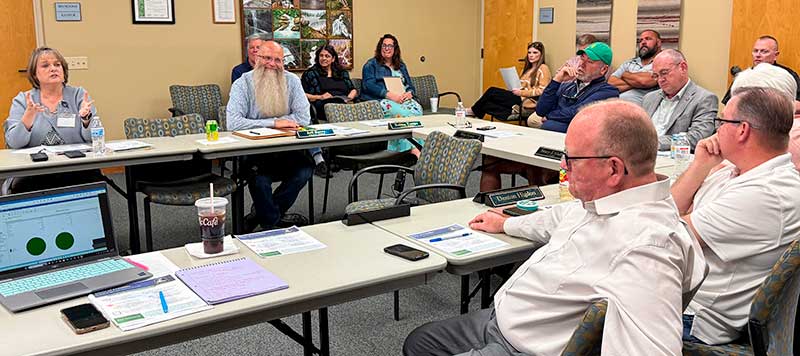
The Franklin Town Council is looking at a $13.6 million budget for the 2026-27 fiscal year.
During the council’s budget work session on April 20, Finance Director Sarah Bishop said that is about an 8% increase over the current year’s budget.
Town Manager Amie Owens said the proposed budget does not include a property tax rate increase. The current tax rate for town residents will remain at 33 cents per $100 value.
“I want to say ‘thank you’ to our department heads for making this a relatively easy process for us,” Owens said. “We sometimes have to say no, and they’ve taken it with grace.”
The budget does include a 5% increase in water and sewer rates.
“We're making a lot of improvements to our water and sewer infrastructure, and with the chemicals and things that it takes to keep things in compliance, costs have gone up,” Owens said. “I would much rather have somebody pay $2.50 more on a utility bill than a penny or two on their tax rate.
Vice Mayor Mike Lewis noted the utility rate increase was part of an improvement plan approved in 2019. Bishop added that costs have gone up since the plan was approved.
Fleet maintenance
A new fleet maintenance department is part of the proposed budget. Bishop said that although there will be some start-up costs in the first year, she anticipates it could save the town money over the long run.
“We want to bring a lot of things in-house that we're currently having to outsource – oil changes, tire changes, rotations, simple things, but also some more advanced repairs as well,” she said.
She said they had been considering adding such a program for a couple of years. “I think we’re in a very good position to be able to do this in-house.”
The town has 72 vehicles in the fleet: 55 vehicles (trucks, SUVs, sedans), seven fire trucks, three ATVs, three dump trucks, two street sweepers, one bucket truck and one sewer pump truck. Thirty-three of the vehicles are more than 10 years old.
Deputy Finance Director Alison Stamey outlined the budget and cost reduction plan for the department:
- Implement a phased replacement plan.
- Focus on replacement and surplus older fleet.
- Use fleet maintenance grading system to make decisions on when to replace a vehicle.
- Continue tracking and focus on preventive maintenance.
Stamey said with service costs on the rise, having an in-house mechanic would help offset those costs. She said some agencies report saving 30%-50% by doing work in-house.
“If we can keep our fleet on a timely maintenance schedule and make sure we're maintaining it properly, they're going to last longer,” Bishop said. “But also, if we can keep a schedule of replacement to where we're surplussing them when they still have some value to them, but maybe not as much to us anymore, we're going to get a bit more return on that than our current plan of 'drive it until the wheels fall off.'”
Lewis said if the vehicles are kept on a regular maintenance schedule there also should be less need for major repairs.
The fleet maintenance plan also includes the following upcoming vehicle needs: two police patrol vehicles, ($100,000), a street department truck ($45,000), two public works trucks ($215,000), one vehicle for maintenance personnel ($30,000) and one medical unit for the fire department ($75,000) for a total of $465,000.
Staffing and other budget increases
In addition to the fleet maintenance mechanic, the proposed budget includes an additional worker for the streets department to help with the increased beautification projects and the extra work that will come with the opening of Sunnyside Park later this year.
The budget includes a 2% COLA (cost-of-living adjustment) for employees, plus the scheduled step increases and a holiday bonus; $200,000 for the Main Street transformation; and $60,000 related to the town’s re-entry to the Main Street program.
Some of the budget items Bishop noted that the town has little control over are a 47% health insurance increase, a 10% increase in property/liability coverage, and increasing retirement costs. Bishop said they are shopping for other health plan options. “We are looking to make it more manageable.”
Bishop said they always budget conservatively – under budgeting on the revenue side and over budgeting on the expenditures.
“We brought those much closer together this year,” she said. We're trying to be more realistic with the budgeting, still conservatively.”
She also noted that while the town generally moved a “pretty good amount” into the fund balance at the end of each year, that probably would not be the case next year.
“We’ll keep an eye on it, and we’ll monitor it through the year. If anything changes, if we have concerns, we’ll let you know, but I don’t expect that we will,” she said.
Fund balance spending
The council also discussed how to spend $2,331,358 from the fund balance. The town’s fund balance policy states a minimum of 80% of the general fund's operating costs will be kept in the fund balance and the balance can be spent on capital expenditures.
Some of the proposed ideas are fencing for Sunnyside Park ($20,000), the Allman Drive boardwalk ($208,000), trash cans and planters ($65,000), snowflakes ($40,000), street and parking lot paving (up to $1 million).
“Having somebody that could mobilize to do multiple paving projects at one time is much more cost-effective,” said Owens.
Owens said they estimated it would cost $250,000 to pave the parking lot at the police and fire departments on Maple Street and $300,000 for the parking lot at Sunnyside.
It was suggested they get input from the staff and council on what streets to consider for paving and get estimates on that.
Another potential project is the next phase of Sunnyside Park, which would include a small amphitheater, multi-purpose pavilion and parking. The town and the ABC Board also continue talking about a new location for the ABC store.
“I would like to point out that everything we’re talking about putting on that list is not going to make the tax rate go up,” Lewis said.
The board will receive the first draft of the line-item budget at the May 4 Town Council meeting. A second budget session has been tentatively set for May 18. The budget must be approved before the new fiscal year starts on July 1.