
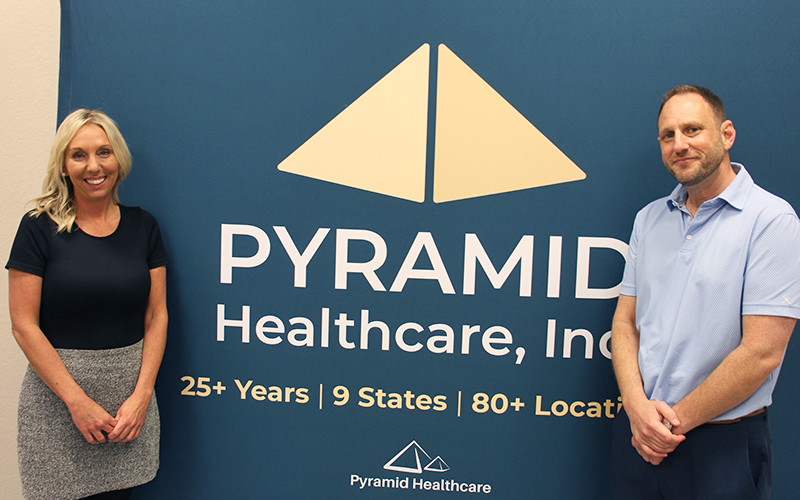
In an effort to address a long-cited need in the community, on April 1 a new outpatient addiction facility opened in Franklin.
Pyramid Healthcare Inc. is already established along the East Coast from Massachusetts down to North Carolina, but the company held the ribbon cutting for its new Franklin outpatient facility Wednesday, April 1, marking the opening of its farthest-west facility. In Western North Carolina, Pyramid offers a collection of services with over 80 substance abuse programs and inpatient services based in Asheville.
In Franklin, patients age 18 and up will be able to take part in substance use treatment, peer recovery services and medication-assisted treatment. According to Bridget Cain, senior vice president of operations, the new location has three employees with as many as five. These employees include a medical director to handle medication management, a licensed clinical social worker, a peer support specialist and certified alcohol and drug counselors.
“So we use intensive outpatient care. So the clients would come here for three hours a day, three days a week,” Cain said. “We also offer medication management.”
Vice president of marketing Dan Gellman said, “What’s really important to us as an organization, and part of what we’ll do here, is treat underserved populations, particularly those that have no insurance or have Medicaid … that’s kind of the core of what we do.”
The location will be working closely with local nonprofits also serving these communities such as No Wrong Door and Appalachian Community Services, collaborating on sharing patients who need different services and extending aid to a wider area. The company is also closely aligned with Vaya Health.
“This is really a partnership between Pyramid and Vaya,” Gellman said. “Vaya was really supportive and really helped to make this a reality.”
Cain said they have been looking to establish in Franklin for around three years with Gellman adding the company has had a presence in WNC for more than 20 years with locations in Buncombe, Madison and Henderson counties. While there may be potential to establish more locations in the far west, they will first have to examine the need through the Franklin office.
Patients requiring more intensive care may be delivered to whatever facility is best for their specific needs, a cost incurred by the company, Cain said. This service would transport anyone to any facility in the nine states in which Pyramid is established.
“So if there’s a client that comes and walks in the door here and they need detox, we would bring them back to the area and treat them at an outpatient level,” she said. “If someone came … and they had severe alcohol withdrawals we couldn’t treat them at an outpatient level because that requires 24-hour medical care for at least five to seven days. But we have facilities where we can offer that.”
DHHS and local treatment
“Pyramid is one of our providers that provide evidence-based treatment and we have been working for several years, and we’ll keep working with local communities and providers to get more evidence-based substance use treatment,” said Kelly Crosbie, director of N.C. Department of Health and Human Services’ Division of Mental Health, Developmental Disabilities and Substance Use Services. “The models of care they provide, they’re very clinical in nature – which I get that not everyone needs in their recovery journey – but the fact that they’re willing to come to a rural community, distribute medications, hire clinicians and peer support specialists, it’s just a big deal.”
She said there are a lot of counties without treatment for opioid use disorders in rural areas statewide. Services like Pyramid’s may also be eligible for Macon County’s opioid settlement funds to take care of those seeking treatment without insurance.
“I think a lot of people don’t realize that some people that come here have insurance which would pay for the service, but there’s still so many people that don’t. And so substance use treatment, especially if you’re getting medications or you come into their intensive program where you come every day for a couple weeks, that could be expensive for a person trying to pay out of pocket. So what happens if uninsured people then can’t get services?” Crosbie asked.
She added DHHS works closely with networks and providers in rural communities to find out what services need funding and assistance, what patients need care, and seek funding from the General Assembly to help improve the quality of those services.
Impact of rural treatment options is not always easy to identify. Ronnie Beale, chair of Vaya Health’s board of directors, said data shows a decrease in overdoses, but this data is only taken from overdoses that are reported, and the opioid epidemic is still very much present. Crosbie added the state’s goal is not only to track overdoses and deaths but access to evidence-based care and life outcomes for those struggling with substance abuse.
“The number of people who have access to evidence-based care, over the past year that’s increased 10%, which is actually huge because that’s hundreds and hundreds more people now that are getting services,” she said. “An important access to care measure that we track is actually around the number of people that engage in treatment a first time and then keep coming back. That’s a huge thing for us especially in substance use, so we actually publish that data. They came and keep coming.”
In tracking life outcomes, DHHS follows if patients are holding stable housing, jobs, seeing reduced symptoms and remaining substance-free. This data is published by DHHS every quarter at ncdhhs.gov/divisions/mhddsus; data collected from Pyramid should start appearing in the reports soon.
“We’re there to listen to communities when they say, ‘We think this is right for our community but we need a little bit extra money,’” Crosbie said. “All credit to the community .. you guys are who did it.”
The facility is located at 110A Macon Center Drive. For information, call 888-618-3520 or visit pyramid-healthcare.com.